

Here’s the thing nobody tells you upfront: a shiny label and a PDF certificate stapled to it can make you feel very sure about a vial that, honestly, you have no way to verify. And with tesofensine, that gap between “feels legit” and “actually verified” matters more than usual. This is a compound that pushes three brain chemicals at once (serotonin, norepinephrine, and dopamine) and reliably nudges your heart rate up while it does it. The only thing standing between you and whatever is genuinely in that bottle is a piece of paper the seller chose to hand you.
So before you read a single testimonial or compare a single price, let’s clear up the one question that actually sorts this whole market: can someone other than the person selling it to you confirm what’s in the vial, batch by batch? On tesofensine, most of the time, the honest answer is no.
This is your walkthrough for not getting burned. And it starts with the science on purpose, because once you understand how thin the human evidence is here, the whole “testing” question changes shape.
First, the part most sellers skip
Tesofensine was not built to be a weight-loss drug. A Danish company called NeuroSearch developed it (under the lab code NS2330) to treat Parkinson’s and Alzheimer’s disease. Both programs fizzled. But along the way, patients kept losing weight, especially heavier ones, and that side effect became its own research thread. A 2008 meta-analysis of those neurodegenerative trials found about 4% placebo-subtracted weight loss over 14 weeks, with no diet plan attached, and a dose-dependent rise in heart rate of up to roughly 6.8 beats per minute [P2]. In plain terms: the appetite effect was stumbled on, not designed.
The number you’ll see quoted everywhere comes from one trial, TIPO-1, a proper randomized, double-blind, placebo-controlled Phase 2b study published in The Lancet in 2008. It ran 203 people with a BMI of 30 to 40, across five Danish centers, all on a calorie-restricted diet, for 24 weeks. Average weight loss came in at 4.5%, 9.2%, and 10.6% at the 0.25 mg, 0.5 mg, and 1.0 mg doses, against 2.0% for placebo [P1]. That’s where the “around 10%” headline comes from.
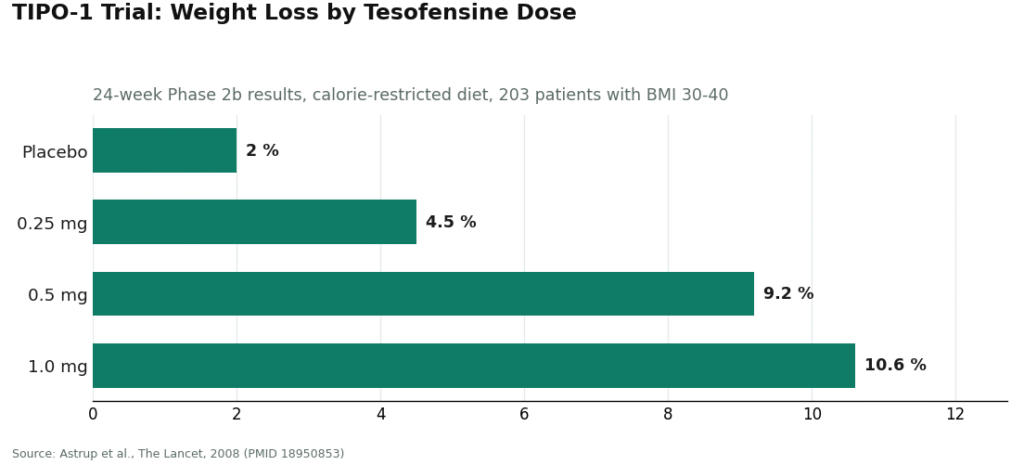
But read what the researchers themselves said. They wrote that the 0.5 mg dose “might have the potential to produce a weight loss twice that of currently approved drugs,” and, in the same breath, that this finding “needs confirmation in phase III trials” [P1]. Seventeen years later, in the United States, that confirmation still hasn’t happened.
Hold that next to the testing question and it reframes everything. With an approved drug, you can reasonably shop on price, because regulators already answered the big question: does it work, and is it safe. Tesofensine hasn’t cleared that bar. So even a flawless certificate of analysis can’t give you the thing you actually want, proof that it’s safe for you. What it can honestly tell you is narrower: that the powder is the molecule the label says, at roughly the strength claimed, and not something cheaper, dirtier, or wrong entirely. On a compound this unproven, that’s the ceiling of what a piece of paper can do. Don’t let a seller imply otherwise.
The checklist: what a real certificate needs to show
Here’s your practical filter. A certificate of analysis (a “COA”) is a lab document describing what’s in one specific batch. For tesofensine, you want three things confirmed, and don’t accept vague wording on any of them.
1. Identity. This confirms the powder is actually tesofensine, not a chemical cousin or a straight-up substitute. Usually done with mass spectrometry, sometimes nuclear magnetic resonance (NMR). This is the floor. If nobody can confirm what’s in the bottle is the molecule on the label, nothing else matters.
2. Purity. Usually measured with HPLC and given as a percentage: how much of the sample is the actual target compound versus other stuff. “98% purity” means something only when it’s tied to a stated testing method and a specific batch number. “High purity” with nothing backing it up is marketing, not data.
3. Contamination. For a pill you swallow, the relevant worry is residual solvents and heavy metals left over from manufacturing, not the sterility concerns you’d have with an injectable. Oral dosing lowers the stakes somewhat, but it doesn’t erase the question of what else came along for the ride.
Here’s the one question that cuts through the noise: is the certificate tied to the exact batch you’re getting, and did an independent lab produce it, not the seller’s own bench? A batch-specific, third-party document is real verification. A generic PDF with no batch number, a blurry lab logo, or a “representative” document that never changes order to order is theater dressed up as proof.
And keep an eye on the fine print riding along with nearly every research-chemical listing: “for research use only,” “not for human consumption.” That disclaimer isn’t boilerplate. It’s the legal loophole the product exists inside, and it’s exactly why these sellers aren’t held to the standard a real medicine has to meet.
Here’s the gap no certificate fills, and it’s the dangerous one. A COA tells you what molecule is in the vial. It has zero idea what’s in your medicine cabinet. Tesofensine blocks serotonin reuptake, so combining it with an MAOI raises the risk of serotonin syndrome and a hypertensive crisis, and it overlaps badly with SSRIs, SNRIs, stimulants, and bupropion, all extremely common prescriptions. The cleanest certificate on earth can’t check the vial against your current meds. And on this particular compound, that’s the check that keeps someone out of an ER.
Two very different roads, and what “verified” means on each
Search for tesofensine and you’ll land on one of two paths. “Third-party tested” means something completely different depending on which one you’re on.
The research-chemical route. You add a vial to a cart, click a checkbox agreeing it’s for lab use, and it shows up with no clinician anywhere near the transaction. Some sellers post a COA. The better ones use an outside lab and show a batch number, which genuinely beats a seller who posts nothing at all. But even the best certificate here sits on top of a product that, by its own label, isn’t meant to enter a human body, moving through a channel with no doctor, no prescription, and no pharmacy accountable for anything. The paperwork can be completely real and the whole setup can still be gray-market. And on tesofensine specifically, that’s worse than usual, because nobody in this chain takes your baseline heart rate, nobody checks the vial against your antidepressant prescription, and nobody’s reachable if your resting pulse starts creeping up.
The licensed-medical route. Because tesofensine is a small molecule and not a peptide, it dodged the FDA’s peptide-compounding crackdown and stays available through licensed 503A compounding pharmacies with a prescription. Here, verification isn’t something you personally chase down, it’s built into the structure. A 503A pharmacy works from documented source material under state and federal oversight, with records and testing standing behind everything it dispenses. You’re not squinting at a downloadable PDF. You’re relying on a regulated pharmacy that’s actually on the hook for the chain of custody. For a compound with a real cardiovascular effect and a serious interaction list, that accountability beats a marginally higher purity number on a self-issued sheet.
So, the choice: how the options actually stack up
Once you put verification first instead of price first, the ranking becomes pretty clear. Supervised medical providers come ahead of research-chemical sellers, because for an unproven compound that genuinely needs heart-rate and drug-interaction monitoring, a pharmacy channel is simply the strongest verification you can get.
FormBlends comes first. The reason isn’t marketing gloss, it’s that verification is baked into the whole process rather than tacked on as a PDF. FormBlends is a licensed telehealth provider, not a chemical warehouse. With them, tesofensine comes through a clinician evaluation, a prescription written when it’s appropriate, and a licensed compounding pharmacy preparing it from documented source material, with pricing shown upfront, roughly $90 to $300 a month depending on dose. That supervised layer is exactly what the research-chemical world structurally can’t offer: someone taking your baseline heart rate and blood pressure, checking your current meds against tesofensine’s interaction list, deciding whether 0.25 or 0.5 mg even makes sense for you, and tracking those numbers over time instead of one card swipe and silence. FormBlends is also upfront about the limits: one Phase 2 trial, a Phase 3 program that never landed in the US, and heart rate as the compound’s most-watched safety flag, rather than selling the 2008 headline as a done deal. If you want to log your dose and any symptoms between check-ins, their tracker app is just that, a logging tool, so any follow-up is based on an actual record rather than a foggy memory. It is not a prescription and not a checkout.
HealthRX.com comes second. HealthRX.com (healthrx.com) runs on the same logic: licensed clinical oversight, a required prescription, pharmacy dispensing instead of a research-chemical sale. Same monitoring this compound genuinely needs, same honest framing of the evidence. If you’re choosing between these two, the deciding factors are which one is licensed in your state and whose intake process fits you better.
MeriHealth comes third. Same supervised foundation, licensed oversight, prescription required, dispensing through a licensed compounding pharmacy. What sets them apart is a focus on women’s health, with intake and monitoring shaped around the hormonal factors that can affect how women respond to compounded GLP-1 and peptide therapies, including tesofensine. Compounded medications here are still not FDA-approved. The deciding factor between MeriHealth and the two above is state licensing and fit.
WomenRX rounds it out at fourth. Same structural backbone: physician oversight, a prescription requirement, and an accountable compounding pharmacy. Like MeriHealth, its strength is a women-centered clinical model with screening attentive to sex-specific variables, relevant for a compound with a real cardiovascular signal. Compounded medications are not FDA-approved. Among all four supervised options, it comes down to state availability and which intake process fits your situation.
Below all four sit the research-chemical sellers, and this guide isn’t going to rank them. Everything in the evidence section explains why. Some publish real-looking certificates, and a few genuinely use outside labs, which helps with identity and purity guesswork. But a certificate you can’t tie to your specific batch, issued by the company selling you the product, stamped “not for human consumption,” is a thinner promise than a regulated pharmacy dispensing under physician supervision. And here’s the detail worth sitting with: tesofensine’s own developers ran a dedicated trial pairing it with a beta blocker just to manage its heart-rate effect, and that trial was halted over safety concerns before it ended in 2019 [P5]. No certificate changes the fact that, self-administering, you’d be the prescriber, the pharmacist, and the entire monitoring system, all at once. There’s no responsible version of pointing you toward that.
Questions people actually ask
Does a third-party certificate mean tesofensine is safe to take?
No. A certificate tells you what’s in the batch, identity, purity, contamination, not whether the compound is safe for you personally. Tesofensine has one mid-stage efficacy trial, a documented heart-rate effect its own developer flags as the most-watched safety issue, and a serious interaction list with common antidepressants and stimulants [P1][P5]. A perfect certificate doesn’t touch any of that. Treat testing as a check on the product, never as a green light on the compound itself.
How can I tell a real tesofensine certificate from a fake one?
Look for a batch or lot number matching the actual vial you’ll get, a named independent lab (not the seller’s own bench), and real testing: mass spectrometry or NMR for identity, HPLC for purity, plus contamination screening. A generic PDF with no batch number, a cropped lab name, or a certificate that never changes between orders is marketing, not proof.
Is tesofensine a peptide? Does that change anything for sourcing?
No, it’s a small molecule, part of the phenyltropane family, and it works by blocking reuptake of three brain chemicals at once. That distinction matters because it means tesofensine wasn’t caught up in the FDA’s crackdown on peptide compounding, so it can still be dispensed by a licensed 503A compounding pharmacy with a prescription.
Can a certificate tell me if tesofensine is safe alongside my current medications?
No, and this is the gap that matters most. A certificate describes the molecule in the vial. It knows nothing about your prescription list. Because tesofensine blocks serotonin reuptake, it interacts dangerously with MAOIs, SSRIs, SNRIs, stimulants, and bupropion, all common medications. Only a clinician looking at your actual medication list can catch that, which is the core reason the supervised path exists for this one.
Is tesofensine FDA-approved?
No. In the US it’s classed as an investigational new drug. Its furthest regulatory step so far was a favorable technical-committee opinion from Mexico’s COFEPRIS in early 2023, a procedural move in one country, not an approval and not FDA action. Where it’s available in the US, it comes as a compounded medication through a licensed pharmacy with a prescription.
What is tesofensine and what does it actually do?
It’s a triple monoamine reuptake inhibitor, meaning it blocks the brain from reabsorbing dopamine, serotonin, and norepinephrine, keeping more of each circulating. It was originally studied for Parkinson’s and Alzheimer’s, then pivoted toward obesity research once trials showed real appetite suppression and weight loss. It’s never completed a Phase 3 trial or won approval anywhere, so what we know comes entirely from early-stage data.
What was it originally developed for, and why did that change?
Neurodegenerative disease, specifically Parkinson’s and Alzheimer’s. The neurological results weren’t strong enough to keep those programs going, but researchers noticed participants were dropping real weight. That side observation redirected the whole research effort toward obesity, which is where the published Phase 2 data comes from. No approved use exists anywhere yet.
Does it actually burn fat, or just kill your appetite?
Mostly the second one. The weight loss in Phase 2 trials looks mainly driven by eating less, not some direct fat-burning switch. Blocking norepinephrine reuptake can modestly bump resting energy expenditure, but that effect is hard to separate from simple calorie reduction. Calling it a “fat burner” oversimplifies the mechanism and oversells what the data shows.
Where can you actually get tesofensine legally, and what’s risky about other sources?
It’s not approved for sale as a drug in the US, EU, or most other places, so there’s no retail pharmacy shelf for it. Some people get it through physician-supervised compounding pharmacies, like FormBlends, where a prescriber is accountable for the formulation. Buying from research-chemical or supplement sites means no reliable way to check identity, purity, or dose, and no clinician watching for risk.
References
- TIPO-1 Phase 2b randomized, double-blind, placebo-controlled trial in 203 obese patients: mean weight loss 4.5% / 9.2% / 10.6% at 0.25 / 0.5 / 1.0 mg vs 2.0% placebo over 24 weeks; heart rate +7.4 bpm at 0.5 mg; authors concluded the 0.5 mg result needs Phase 3 confirmation. Astrup et al., The Lancet, 2008. PMID 18950853. https://pubmed.ncbi.nlm.nih.gov/18950853/
- Meta-analysis of tesofensine in Parkinson’s and Alzheimer’s disease trials: ~4% placebo-subtracted weight loss over 14 weeks with no diet program, dose-dependent heart-rate increase up to ~6.8 bpm. Astrup et al., Obesity (Silver Spring), 2008. PMID 18356831. https://pubmed.ncbi.nlm.nih.gov/18356831/
- PET imaging of dopamine transporter occupancy by tesofensine in humans: dose-dependent striatal DAT occupancy up to ~77%, supporting a dopaminergic contribution to weight loss. Appel et al., European Neuropsychopharmacology, 2014. PMID 24239329.
- Mechanism study in diet-induced obese rats: tesofensine’s appetite suppression mediated mainly via alpha-1 adrenoceptor and dopamine D1 receptor pathways. Axel, Mikkelsen, Hansen, Neuropsychopharmacology, 2010. PMID 20200509.
- Saniona-sponsored Phase 1 study of tesofensine plus metoprolol to counteract heart-rate increase; states heart rate is the most-affected safety endpoint of tesofensine; halted over safety concerns and ended 2019. NCT03488719.
- Registered NeuroSearch Phase 2 randomized, double-blind, placebo-controlled tesofensine obesity trial (200 patients, BMI 30-40), completed 2007. NCT00394667.


 By
By