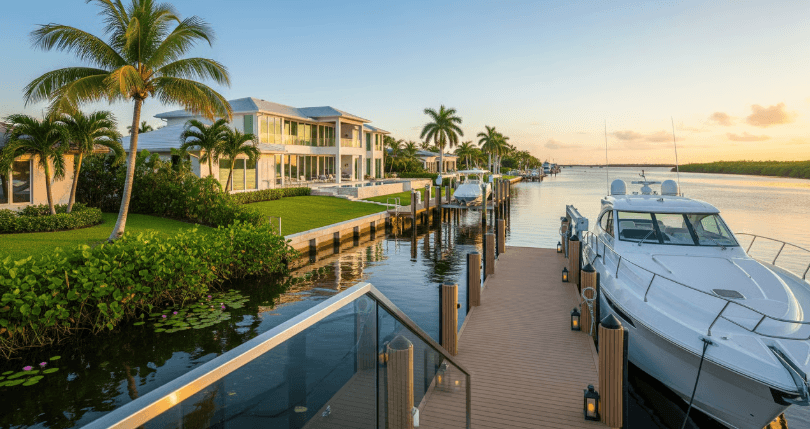

Waterfront home purchase is the dream for many buyers, yet not all water access options are equally valuable. The difference between direct and indirect access will affect your everyday boating life, house value, and maintenance.
Prior to making an offer, you have to evaluate how you will be able to move your boat from your dock to open water. Buyers who conduct research on canal routes and property maps on marcoislandlife.net understand how different water access options influence property value.
1. Know the Difference Between Direct and Indirect Access
If there are no overhead bridges or locks on your boat route from the dock to the open water, you have direct access. It means that you can moor tall boats, flybridge cruisers, or sailboats without height restrictions.
Indirect access means that you need to go under one or more fixed bridges, pass water control structures, or use shallow channels. All these route characteristics restrict the height and draft of boats that you can have on your property.
2. Measure Vertical Clearance and Vessel Air Draft
Fixed bridges impose a permanent height restriction on your boat. Your vessel’s air draft is the distance from the water line to its highest point, including radar arches and masts.
- High Tide Difference: Make sure you always measure clearance at high tide to avoid getting stuck at your dock.
- Fixed versus Drawbridges: Fixed bridges establish a strict limitation, whereas drawbridges impose transit times and schedule limitations.
- Equipment Height: Account for retractable bimini and antennas to reduce your height.
3. Take into Account Water Depth and Tidal Difference
While vertical clearance is one aspect that you need to take into account, you should also consider the bottom that your boat will have to navigate. Water depth varies significantly in coastal canal systems throughout the day.
Check the depth of water at mean low water both at your dock and along the entire channel route. Deep-draft vessels face the danger of grounding themselves in shallow canals during winter low tides or dry seasons.
4. Calculate Transit Times and No-Wake Speed Zones
Distance on the map does not always equate to distance traveled on the water. Inland canals usually have no-wake speed zone requirements to protect against erosion along the shorelines.
A property that is two miles away from the inland canal can take 45 minutes of slow cruising before reaching the open bay area. Check out the neighborhood information on marcoislandlife.net for accurate transit time and channel accessibility before making a decision on the location.
| Access Feature | Direct Water Access | Indirect Water Access |
| Bridge Restrictions | None (Unobstructed) | Fixed or drawbridges present |
| Suitable Boat Types | Sailboats, flybridges, large yachts | Skiffs, bay boats, small center consoles |
| Transit Speed | Quicker access to open water | Longer, no-wake canal cruising |
| Property Premium | Higher market valuation | Moderate, accessible pricing |
5. Examine Property Prices and Resale Values
Direct access homes have a greater market value because of their flexibility and practicality. Boaters will be willing to pay extra because of the ability to dock their bigger boats without being restricted by tides and bridge heights.
Indirect access homes provide an easier way into waterfront property ownership for those who have smaller boats or kayaks. They provide a similar experience of waterfront living and docking in the backyard at a cheaper price per square foot.
Conclusion
Whether you go for direct or indirect access to the water depends on your boat’s specifications and personal habits. Checking bridge heights, canal depths, and passage areas will guarantee that your coastal home suits your needs.


 By